

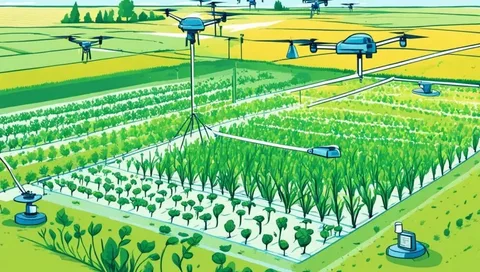
In the modern era of farming, the integration of technology and agriculture is revolutionizing the way we manage soil health. The shift from data to dirt: how precision agriculture is transforming soil health monitoring offers farmers a new lens to understand and nurture their fields with unprecedented accuracy and efficiency.
The Growing Need for Advanced Soil Health Monitoring
Soil health is the cornerstone of sustainable agriculture. Traditional methods of soil analysis often involved manual sampling and lab testing, processes that were time-consuming, expensive, and offered limited spatial resolution. With the rise of precision agriculture, these limitations are being addressed by leveraging technology to provide real-time, detailed insights into soil conditions.
Farmers now have the ability to monitor nutrients, moisture levels, pH, and microbial activity across their fields with pinpoint precision. This data-driven approach not only enhances crop productivity but also promotes environmental sustainability by reducing overuse of fertilizers and chemicals.
From Data to Dirt: How Precision Agriculture is Transforming Soil Health Monitoring
The phrase from data to dirt: how precision agriculture is transforming soil health monitoring captures the essence of this technological revolution. Precision agriculture employs a variety of tools such as soil sensors, GPS mapping, drones, and satellite imagery to collect vast amounts of soil data. These technologies allow for the analysis of soil variability within a single field, enabling customized management practices tailored to specific zones rather than applying uniform treatments.
By transforming raw data into actionable insights at the soil level, farmers can improve soil health management in several ways:
- Targeted Nutrient Management: Applying fertilizers only where and when needed to avoid nutrient runoff and soil degradation.
- Optimized Irrigation: Ensuring soil moisture is maintained at optimal levels to support healthy root growth.
- Early Detection of Soil Problems: Identifying issues such as compaction, salinity, or erosion before they severely impact crop yields.
Tools Driving the Revolution: Soil Sensors and Data Analytics
One of the critical components in the journey from data to dirt: how precision agriculture is transforming soil health monitoring is the use of advanced soil sensors. These devices measure variables like soil temperature, moisture, electrical conductivity, and nutrient content in real-time. Coupled with powerful data analytics and machine learning algorithms, these sensors help interpret complex soil patterns and predict future conditions.
Farmers and agronomists can visualize these insights through easy-to-understand digital maps and dashboards, enabling smarter decision-making that ultimately enhances soil vitality and crop performance.
The Environmental and Economic Benefits
Improving soil health through precision agriculture translates directly into environmental gains. Healthier soils sequester more carbon, reduce erosion, and support biodiversity. Economically, farmers benefit from higher yields, lower input costs, and greater resilience against climate variability.
Conclusion
The journey from data to dirt: how precision agriculture is transforming soil health monitoring marks a significant leap forward in sustainable farming practices. By harnessing technology to gather and analyze soil data at an unprecedented scale and precision, farmers can cultivate healthier soils and more productive crops while minimizing environmental impact. As this technology continues to evolve, the future of agriculture looks increasingly smart, efficient, and sustainable.